Southaven’s no-kill shelter offers a safe haven for its furry forlorn

By: Adam Hogue

4/20/16

Embodying every sense of the word “shelter,” Southaven Animal Control officers in DeSoto County who operate the no-kill, Southaven Animal Shelter strive to protect the voiceless, four-legged friends who often find themselves in harm’s way.

Of the 1,107 dogs and cats that the shelter took in in 2015, 350 were successfully adopted out, and 204 were returned to their owners.

“A no-kill shelter is defined as anybody who puts down less than 10 percent of their adoptable pets, and we’re like, at 7 percent,” said Kristin Ellis, 29, who works at the shelter as an administrative assistant as well as once serving as an animal control officer.

Serving the third largest city in the state of Mississippi, the shelter faces an enormous task in effectively maintaining the city’s animal control needs. The Southaven Animal Shelter prides itself on its ability to not only serve the city, but also maintain its status as a no-kill shelter.

“They stay here until they get adopted, but how long that takes depends on the dog really,” Ellis said of the animals in the shelter. “We’ve had some dogs that have been here, you know, 700 or 800 days before they got adopted.”

The shelter in Southaven never gives up on the animal or the chances of finding that animal a home. Ellis said that other DeSoto County animal shelters have other, less gracious policies for handling some of their furry residents, specifically the DeSoto County Animal Shelter, which serves the majority of the county’s more rural areas.

“The county puts down pit bulls every Tuesday,” Ellis said. “They don’t even adopt them out anymore.”

The DeSoto County Animal Shelter is located in the unincorporated community of Nesbit at 1251 Humane Way.

“They put them all down,” Ellis said of the pit bulls kept in the county shelter, then reiterated the Southaven shelter’s policies. “We have a lot of pit bulls back there right now, pits and pit mixes; we adopt them all out.”

Southaven Animal Control officers even go the extra mile when setting these misunderstood and often prejudged pups for adoption.

“We don’t let any pit bull leave here without getting fixed,” said Ellis. “We actually take them to the vet and drop them off for their surgery ourselves because we don’t want them (pet adopters) to just not show up for the surgery.”

The Southaven shelter regularly brings in veterinary students from Mississippi State to spay and neuter its animals. Because of the shelter’s spay and neuter program, 155 of their dogs and cats were fixed in 2014, and 225 in 2015.

“A lot of people don’t realize the benefits of it,” said Marsha Yates, a five-year veteran of Southaven Animal Control.

Spaying and neutering pets does not make the list of priorities for some pet owners, and often times animal control officers are left to deal with the fallout.

“It calms the animal down, it lessens the population of having strays, and it also lessens having dogs in the shelter,” said Yates.

Denisa Young, who has worked as the adoption clerk for Southaven Animal Control for 10 years, said that the Southaven Animal Shelter takes extra measures to care for all of its animals, including offering spaying and neutering services for all of its adoptable pets.

“When you come in and adopt an animal, if it’s not spayed or neutered we set an appointment up to get it spayed or neutered,” Young said.

Young said that the pet adoption process is done in a way that benefits both the animal and the pet’s new parents, including covering the cost of shots given by the veterinarians during their surgeries, as well as offering the new pet owners several supplies in addition to having the animal fixed.

“We’ll set you an appointment, you’ll take it to the vet,” Young said of the adoption process. “You’ll get that (the spaying or neutering service) which is a $30 fee, which actually we pay for that, all you pay for with that 30 is a $15 rabies shot and a $15 pain shot.”

“So, for 50 bucks here at this shelter you get an animal, get it spayed or neutered, get its rabies shot, pain shot, a bag of food, a leash, and you’re good to go,” she said.

While the shelter takes every step that it can in order to ensure a positive pet-adopting experience, Young admits that Southaven’s growth has impacted the shelter’s operations.

“We have annexed so big, Southaven has, that we stay full,” Young said. “I mean I’ve got relinquishments now, people want to turn their dog over, I don’t have the room yet; I’ve got to adopt a couple out, call them, and get them to bring theirs up.”

Young said that in times of desperation, she understands pet owners’ hesitations in giving their animals over to a shelter, but she insists and wishes the public to know that her department always has the animal’s best interest in mind, and always shows sympathy to those who feel they need to give their pets up to the shelter.

“No judgments,” Young said with a smile.

“As long as we have the room we’ll take their dog in, and we’ll let them know they’re more than welcome to come up here and check on their dog,” Young said. “They can come up and play with their dog, and they can call us on a daily basis. If their dog gets adopted, we’ll let them know.”

Young also has a message to those who might visit a pet store rather than an animal shelter when shopping for a new pet.

“The people that have never seen a shelter should go look and see, just walk through, adults and kids,” she said. “I say they’re more lovable here,” Young said of the shelter’s animals. “Because they’ve been out on the street they need love, they’re looking for love.”
Space heaters cause hot mess for Olive Branch firefighters

Adam Hogue

2/3/16

Cold winter temperatures often cause problems including frozen water pipes and sniffling noses, but perhaps the most dangerous threat during these frigid and dark months is the risk of fire often caused by space heaters.

In the city of Olive Branch, firefighters stay on high alert during the cold months, anticipating the inevitable distress calls.

One recent incident took place on Jan. 18 at 2818 Lake Forest Road in Olive Branch, Mississippi. Emergency responders were called to the scene of a family home after a fire broke out in a first floor bedroom.

“We can be pretty busy in the wintertime,” said Olive Branch fire and emergency responder Rickey Rials. “A lot of times it has to do with those little space heaters that people use a lot during this time of year.”

Inspectors said that the cause of the fire came from a spark due to an overloaded extension cord. Fire crews were able to contain the blaze within the bedroom and extinguish it and no injuries were reported in the incident.

Estimates from the U.S. Consumer Product Safety Commission indicate that more than 25,000 residential fires every year are related to space heaters.

“The problem is,” Rials said, “people buy these little cheap, brown extension cords, the ones that are about the width of a phone cord, and they overload them with four or five different things plugged into it.”

Rials said that these extension cords simply are not made to handle many appliances being plugged into them.

“What happens is when you have all these things plugged into the cord it gets overheated and it causes it to literally melt,” he said. “It just so happens that the cord is usually laying on the carpet or somewhere and it causes a fire to start.”

Olive Branch citizen and pizza restaurant owner Robyn Johnstone, 56, says that she generally tries to refrain from relying on space heaters due to the risks they pose.

”Not too long ago the heat went out here at the restaurant and I thought about going out and getting a little space heater or two,” Johnstone said. “But I was just hesitant about getting one, so we all just kind of bundled up at work until we could get someone out to fix our thermostat.”

However, though space heaters can often be linked to the cause of fires during the winter, Rials says that it is not the space heaters themselves necessarily, but rather the manner in which they are used that causes the problems.

“I would advise that people not plug more than one into one extension cord,” Rials warned. “Don’t leave them running for long periods of time. Try not to leave them on all night, or maybe even buy one that has a timer.”

Millennials murdering traditional mass media..?

Adam Hogue

3/3/16

Considered by some to be the worst generation yet to walk planet earth, “millennials” are categorized as any person born between the years of 1982 and 2004. This group is often considered to be lazy, narcissistic, oversensitive, demanding, unappreciative, out of touch with reality, and uninformed. A 2015 study conducted by the Pew Research Center showed that on average, millennials correctly answered only 7.8 questions out of 12 on a quiz regarding news and current events, the poorest score of any generation.

This could perhaps be due to millennials’ habits and practices. They can often be found either protesting at a rally, criticizing people who do not agree with their ideas (particularly older generations and other cultures), or with their faces buried in their smartphones, constantly tweeting, posting, sharing, liking, and updating, regardless of how insignificant the information.

The effects of millennials’ behavior can be observed anywhere there is a social gathering. Whether at school or at a dinner table, the art of conversation is no more, forever replaced by the false sense of friendship provided by social media. These millennials, this group of insouciant imbeciles, would rather get their friends lists, or number of followers from 1,000 to 1,001, than to make one friend with a genuine face-to-face conversation.

As to be expected, millennials have impacted our society in more ways than just skinny jeans and hipster haircuts. Pop culture routinely adjusts itself to please these mass consumers (disregard that it’s their parents’ money with which they do the consuming). The movie industry has shifted from legitimate plots and storylines with real characters to, “let’s see how many special effects we can create with CGI.” Likewise, nowadays, anyone who can rhyme two words together and put them to a drum machine thinks that he or she is going to be the next great “musician.” Youtube is full of inept halfwits who feel compelled to share their inadequacies with the world, and God forbid anyone attempt tell them the truth about their actual lack of talent; those people are just “haters.”

Perhaps the most alarming aspect of our lives that millennials have polluted with their actions is the way in which we receive our information. The need for studying or reading textbooks for information and answers has been replaced with the internet. Why put the effort into learning or retaining anything noteworthy when an internet search engine can provide limitless amounts of information within seconds? Google’s search engine has successfully replaced Golier’s Book of Knowledge.

Along with this accessibility of immediate answers comes the decline of traditional broadcast media. With this growing age of technology and instant access to information, many millennials rely on their smartphones for news rather than a 9 p.m. broadcast from a local news station. With the option of having alerts sent straight to their phones, the need for regularly scheduled news programs seems to be waning for millennials.

Summer Morgan, a volleyball player at the University of Memphis, still catches the occasional local news broadcast, but said that she does not heavily rely on it for her information.

“I have it set up to get notifications on my phone for news stories,” Morgan said. “I mean, I’ll turn on the TV at night, like the 10 o’clock broadcast when I’m going to sleep, but yeah, for the most part I get it through notifications.”

Travis Offield, a 24 year-old University of Mississippi graduate, falls into the same group as Morgan.

“Most of the time I just don’t have time to sit down and watch the news,” Offield said. “It’s not that I wouldn’t, it’s just more convenient to get that information from my phone than to try and catch an actual program.”

This proposes the question: are millennials killing traditional mass media, or is mass media failing to evolve to meet the needs of the public? As it turns out, millennials are not completely out of touch (with everything). They do not completely disregard the news and current events in the world; they simply receive their information in a nontraditional way.

Mass media has taken steps to address these issues, such as offering live streaming news to users’ smartphones, and if they can somehow continue to stay in conjunction with the needs of the ever-demanding public, or even a step ahead of it, mass media sources may not disappear completely anytime soon.

Clinton campaign makes waves in Whitehaven

Adam Hogue

2/17/16

As the temperature dropped into the 30s on the night of February 11, the line of people waiting outside Whitehaven High School’s gymnasium doors grew longer, growing to over 300 as it stretched across the front of the school and down the sidewalk along Elvis Presley Boulevard.

The crowd had assembled to welcome former President Bill Clinton as he made a campaign stop in the Memphis area touting support for his wife Hillary, who is vying for the Democratic Party nominee for the 2016 presidential election.

“It was a once in a lifetime opportunity to see him speak,” said Mid-South resident Syed Ali Jaffery, 25.

Jaffery waited in line outside of the gymnasium with his father and younger sister for 40 minutes to get a glimpse at the former leader of the free world.

The evening began with the Whitehaven High school band performing in front of the crowd of the over 600, many waving Hillary campaign signs and banners. U.S. Reps. Steve Cohen, D-Memphis, introduced Clinton to the cheering crowd as they took their places on a stage with a large Tennessee state flag serving as the backdrop.

Clinton touched on several topics that resonated with the audience including creating more jobs and making college more affordable for low-income families. He also tipped his hat to the Black Lives Matter campaign noting that “we are sick of seeing kids shot in the street,” as he touched on the issues that plague Memphis, specifically its violent crime rate and high unemployment rate.

Lower healthcare co-payments and the need to improve the economy were also prevalent topics of his speech. However, Clinton acknowledged the job that President Barack Obama has done while serving in office.

“The president has done a better job than he has gotten credit for,” Clinton said of Obama.

Clinton said that some of the major goals of the Hilary campaign include voting rights protection and raising the minimum wage, saying that there is no reason why anyone working 40 hours a week cannot afford a comfortable life.

“Hillary has said to me in private what she is now beginning to say in public,” Clinton said of his wife. “’I only decided to do this and take all this grief that Republicans always lay on me because I do not think you should have to be the daughter or granddaughter of a president or former secretary of state to claim the American dream.’”

The Nevada primaries will be the next challenge for Hillary Clinton as she looks for a victory after losing New Hampshire to Bernie Sanders. Bill Clinton touted his wife’s ability to “get the job done.” He advocated his wife as someone who could be “a president who knows how to stand her ground and how to seek common ground.”

“In my opinion you need to know why somebody’s running,” Clinton said to the crowd. “She’s running to give every young person, every middle-aged person who’s lost a job and facing a dead end, and every child, without regard to income, the chance to live the American dream.”

Jaffery considered Clinton’s visit to Memphis to be successful.

“Most people seemed receptive to his ideas,” Jaffery said.

The Tennessee primary is scheduled for March 1. Early voting began Feb. 10 and goes until Feb. 23.

DeSoto County’s newly elected superintendent brings experience and excitement

By Adam Hogue

3/3/16

DeSoto County, nestled in the shadow of the city of Memphis just across the Mississippi state line, boasts the second largest public school system in the Memphis metropolitan area. With 34,000 students spread out across 42 schools, the DeSoto County Schools system is the largest in the state of Mississippi, and at the helm of it all is newly-elected Superintendent of Education Cory Uselton.

Uselton replaced former Superintendent Milton Kuykendall in the wake of his retirement. In the August 2015 election, Uselton won the votes of north Mississippi residents with his vision for the county’s young minds.

“I want for all of our students to have the opportunity to be successful when they graduate from high school, and I want our school district to be recognized as one of the top school districts in the nation,” Uselton said.

Hailing from Humboldt, Tennessee, Uselton, 47, who originally graduated from the University of Memphis in 1991 with a degree in business administration, also holds a master’s degree in education from Delta State University, and a specialist’s degree in educational leadership from the University of Mississippi. Now in his 22nd year in the field, Uselton said he was drawn to education because of the influences he had growing up.

“I wanted to help students just like the teachers and coaches that I had in high school,” Uselton said.

The decision to try his hand at superintendent seemed predetermined for Uselton. DeSoto County’s new superintendent got his start as a social studies teacher and head boys’ basketball coach at Pontotoc High School in Pontotoc County, Mississippi, and from there Uselton’s rise in the field of education has been full of accolades.

In 2015, Uselton was named the Mississippi High School Principal of the Year by the National Association of Secondary School Principals for the 2014-2015 school year. Just one year earlier, he was named the 2013 Principal of the Year for DeSoto County Schools, as well as being named the 2013 Administrator of the Year for the First Congressional District of Mississippi.

Horn Lake Middle School history and theater teacher Cara Smith said she believes that DCS is in great hands with Uselton. Smith worked with Uselton at Horn Lake High School where he served as an assistant principal from 2004 to 2007.

“The things that made him a strong assistant principal and principal will make him a strong superintendent,” Smith said of Uselton. “He is decisive and believes in taking action and moving forward; I’m excited about where he will lead our district.”

Now in his 13th year with DCS, Uselton is not unfamiliar with the issues facing his school system.

“We still have the challenge of steady growth in DeSoto County, and our schools have only been fully funded on just a few occasions,” Uselton said.

FB_IMG_1458169626282

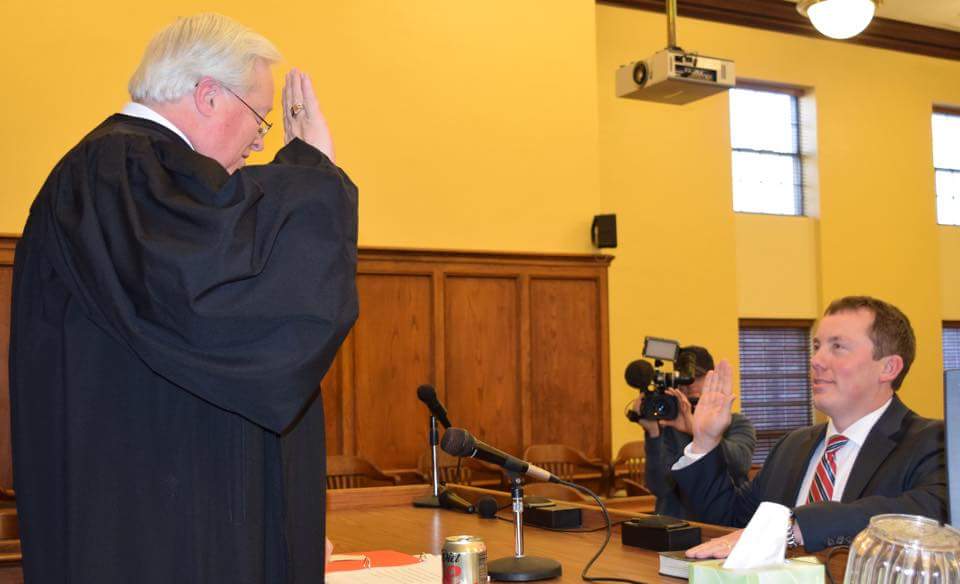
Cory Uselton is sworn into office of as the superintendent of DeSoto County Schools in this Facebook photo. Uselton now oversees the largest public school system in the state of Mississippi, with 42 schools and 34,000 students.

DeSoto County consistently ranks as one of the largest growing areas in the country as far as population is concerned, mostly accredited to the exodus of Memphis residents as they escape the city and settle in the county. Uselton says that being in a suburb of Memphis provides “quite a bit of attention and notoriety,” as well as an extra strain on school officials as they attempt to confirm the incoming students’ records.

“We have many students each year that come to DeSoto County from Memphis and other areas in the Mid-South,” Uselton said. “As long as the parents have a legitimate residence, everything is fine, but we have to make sure that the parents really do live here.”

Officially sworn into office on Jan. 3, Uselton described his first two months in office as “exciting,” but admits that he is still adjusting to some aspects of the job, including time management.

“It’s hard to accommodate everyone’s requests,” he said. “I want to attend as many school events as possible, but it’s just not possible to attend everything that I am invited to.”

A member of Hernando Baptist Church where he serves as a deacon, Uselton is involved in the community outside of the school system. He and his wife Amanda have two young sons, Jackson, 12, and Will, 9, who both attend Hernando schools and participate in basketball and competitive soccer leagues. And recently, Uselton made his theatrical debut, being seen in DeSoto Family Theatre’s Christmas production of the classic “Miracle on 34th Street.”

“It was a great opportunity to showcase the relationship between DFT and DeSoto County Schools,” said Uselton. “I really enjoy representing DeSoto County Schools.”


About Cory Uselton 

Age: 47

Education: University of Memphis, Delta State University, University of Mississippi

Career: DeSoto County Schools Superintendent of Education

Family: Wife, Amanda; sons, Jackson and Will

Favorite ice cream: Chocolate

You have the day off from work and no immediate responsibilities to handle; describe your perfect day off. Just spend time with my family.


Mormon missionaries make the most of opportunity presented by visiting musical

By Adam Hogue

3/30/16

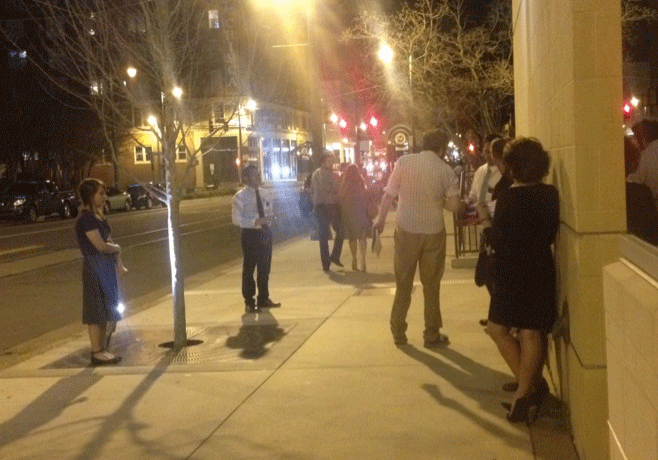
Dozens of Mormon missionaries could be found along Main Street and Beale Street outside of Memphis’ Orpheum Theatre last week, offering a smile and information to theatre patrons as they made their way to see the Broadway musical, “The Book of Mormon.”

One of those missionaries was Elder Joseph Butler, a 21-year-old believer serving out of Salem, Utah. Butler said that the musical offered a great opportunity for members of the church to spread their beliefs in a way that theatergoers could find familiar.

“Well, as missionaries our purpose is to invite others to come into Christ, and we want to invite as many people as we can,” Butler said. “And so seeing this as an opportunity to talk to a lot of people that kind of have something to connect it to, we thought it was a great opportunity to get to share the message with as many people as possible.”

Butler and his group of accompanying missionaries arrived about one and a half hours before the start of the show and stayed until midnight, passing out information cards and copies of the actual Book of Mormon to people before and after the show. Butler said that the response from people was overwhelmingly positive.

“Most people are appreciative of someone who’s doing something out of the comfort zone because they love doing it,” Butler said. “And so everyone’s usually pretty nice, pretty courteous about it; I think it’s overall a positive reaction.”

The Church of Jesus Christ of Latter-day Saints places a high emphasis on spreading the message of their beliefs. Members of the church travel around the world engaging in community service, humanitarian aid, and informing anyone with whom they come into contact about their faith.  By the end of 2014, the church reported that it had over 85,000 missionaries serving worldwide.

The Book of Mormon” the musical revolves around two of these young Mormon missionaries as they are assigned to their first mission in Uganda, Africa. Upon their arrival, the two are met with the harsh realization that life for the African villagers is that of disease, war, and extreme poverty, and that the task of spreading their message of Mormonism may not be as easy as they had anticipated.

Seeing the musical for the first time was 22-year-old Jacob Woloshin, a senior journalism major at the University of Memphis.

“I’d heard from friends and family that it’s kind of a raunchy play, and watching Matt Stone and Trey Parker shows my whole life, you know I thought with all the awards it won it could be a very, very fun experience,” Woloshin said. “And it was.”

“The Book of Mormon,” crafted by critically acclaimed artists Robert Lopez, Matt Stone, and Trey Parker, debuted on Broadway’s Eugene O’Neil Theatre in March 2011 and was met with raving reviews. That same year, at the 65th annual Tony Awards, the production won nine of the 14 nominations it had received, including Best Musical, making it one of the most highly decorated shows in all of musical theater history, joining the likes of Mel Blanc’s “The Producers,” which won 12 awards.

Woloshin, who attended the musical with his father, stepmother and brother on opening night, initially believed that the missionaries outside of the theater were part of the musical.

“They were standing there being very friendly and offering up their literature for their religion,” Woloshin said. “If you passed them they would just politely ask you a question, they weren’t really going to get people; they were just kind of waiting for the opportunity really.”

The missionaries were not allowed to stand directly in front of the theater, but lined the adjacent streets and street corners, striking up conversations with passers-by.

“We were walking up to him and basically he was just like, ‘Did you guys enjoys the show?’ and we were like yeah, and he was like, ‘Well do you want the real thing?’ and then he showed us the book,” Woloshin said of his encounter. “And I was just like oh, I appreciate it, but no thank you.”

Mormonsshopped

Members of The Church of Jesus Christ of Latter-day Saints hand out information to theatergoers leaving “The Book of Mormon,” on Tuesday night. The musical, showing at the Orpheum Theatre March 15-20, focuses on Mormon missionaries’ efforts to spread their faith around the world.

As far as the musical was concerned, Woloshin said that he and his family “absolutely loved” the production, and the accompanying audience seemed to feel the same way.

“I don’t know if there was an empty seat,” Woloshin said of the 2,500-seat theater that night. “It really was like, very loud and people were going crazy for it, they loved the songs; you got like a massive applause after every one pretty much.”

Although familiar with the show’s success and cultural impact, Butler said that he has no intentions to see the show anytime in the near future.

“Uhm, probably not, probably not,” Butler said while laughing. “Just because I’ve heard it has some explicit content I guess.”

Explicit content, indeed, a fact that Woloshin acknowledged as well.

“I’d say if you’re easily offended by religious jokes, I don’t think it’d be the place for you,” Woloshin said.

Local woman overcomes tragedy, cites faith as her strength

Melody Owens was 16 years old and sitting in the middle of the front seat of the family car as her father made the long haul from the family’s home in southern Illinois to the state of Washington where they had planned to spend their vacation. Her younger brother was sitting to her right, while her mother sat in the backseat with her two additional younger brothers as they made their way through the night along the interstate.

Suddenly, the car skids out of control and slams against the guardrail. Glass shatters and the night’s silence is pierced by the sound of metal grinding against metal as the car scrapes along the barrier for over 140 feet before spinning to a stop only to burst into flames.

Her father is thrown from the vehicle to the other side of the road, his leg mangled and broken in four places. After regaining her senses, Owens finds herself trapped in the car staring at a wall of flames, her chest pinned by the steering wheel. From his immobile position on the roadside, her father desperately screams, pleading for his family to make their way out of the engulfed vehicle.

“I can remember waking up that night,” Owens recalls, “and it was so bright because the fire was all over the windshield. I remember him calling my name, and he would call each one of our names, and he was saying, ‘Get out of the car! Melody, get out of the car!’ I could hear that, and as a kid I was trying to obey and do what he said to do.”

Following her father’s voice, Owens fought through the pain of a broken arm and forced the steering wheel off of herself, then noticed her brother who was still beside her in the front seat.

“I thought, ‘If I could just get his seatbelt undone and push him out the door, I’ll come around and get him,’ because I’m not comprehending how bad it is,” Owens remembers.

In that moment, Owens heard a voice speak to her.

“My arm was broken and I couldn’t get the seatbelt undone. And although it seemed like minutes I’m sure it was only seconds because I wasn’t burned that bad, but a voice clearly said to me, ‘Don’t do that, he’s dead. Just get out, get out of the car,” Owens said assuredly. “And I know that was the Holy Spirit speaking to me.”

Owens heeded the instructions she had been given and navigated her way out of the car. With her clothes on fire, she walked to the other side of the interstate and collapsed, succumbing to the pain. From this distance she was able to fully observe the chaos.

Traffic had come to a standstill. The black of the night was illuminated by the inferno that was once a family car. No one made any efforts to exit their cars and help Owens’ family.

“You can’t imagine how horrible that would be,” Owens said, “to be across the road there, not able to get over and save your family, but you can see, you can see it. You can see your family’s inside that car and you can’t help them.”

Owens’ mother was still inside the car along with her three younger brothers. Her father, still helplessly screaming, began directing his instructions to his wife, who was trapped in the backseat. Her arm was not only broken, but all of the bones in it had been crushed, rendering her virtually powerless to find her way to freedom from the firestorm.

“After an eternity she finally did; she fell into the flames here,” Owens told, motioning to the floor. “That was as far as she could go.”

Owens mother lied in the pool of flames and she recalls her father beseeching passers-by to “Please help her, please help her…”

Owens notes the most dispiriting aspect from her night of horror was the lack of assistance that was given to her family in their time of desperation.

“It still bothers me and it still hurts to think that nobody offered,” Owens reminisced, her voice cracking as the light from the room caught tears that welled up in her eyes, causing them to sparkle. “Nobody did.”

Although her accident happened over 40 years ago, Owens still struggles with the memories it etched into her mind. Now a retired schoolteacher, Owens uses her time to focus on herself, her health and her relationship with God. She “still gets her thrills” from teaching by leading a Bible study group on Wednesday nights for adolescent girls.

Owens credits her experience for her strong faith. In the accident, Owens lost all three of her younger brothers, ages nine, 12, and 15 at the time. Her mother was burned on over 85 percent of her body and had to spend a year in a burn ward. Owens never returned to finish her senior year of high school.

Through everything, Owens maintains an optimistic disposition, crediting her firm belief in God for her positive outlook. She leads a tremendously active lifestyle, walking four miles every day and dancing. Owens is a line dancer and has performed most recently at the Delta Fair and Mid-South Fair.

“And we did a flash mob in Batesville last Saturday,” Owens said with a grin.

“I just know that God has a reason for me to survive all this and I just try to give back and try to do what he wants me to do,” Owens said with conviction. “And through everything he’s been with me.”


DeSoto Family Theater keeps audiences guessing with Christie mystery

DeSoto Family Theatre in Southaven decided to begin the Halloween season early this year by showcasing Agatha Christie’s murder-mystery “And Then There Were None.” Considered a master of suspenseful writing, Christie’s story of hapless house guests comes to life onstage at the Landers Center Theater, DFT’s home, from Sept. 4 through Sept. 13.

With over 100 million copies of the book sold worldwide, and being translated into over 100 languages, “And Then There Were None” is considered to be Christie’s most renowned story.

Cara Smith, who has served as a DFT board member for five years, undertook the task of directing Christie’s timeless tale of trepidation.

“We’ve never done a murder mystery or anything like that,” Smith says. “So it’s brand new to our season repertoire.”

Christie’s story centers around a group of unsuspecting houseguests who have been invited to a cliff-side mansion by a mysterious and unknown host for a weekend stay. During their visit, the guests are murdered one by one. This leaves the remaining guests shrouded in fear, suspicion, and overwhelming tension as they each suspect one another to be the cold and calculating killer, all while worrying which of them will be the next victim.

As patrons enter into the lobby of the theater, they are met with elegant decorations, similar to those that don the set for the play. Golden curtains gracefully drape the walls, tiny Indian statues, no more than six inches tall, and a plethora of Christie’s books adorn the ticket table in the lobby. Hanging on the wall behind the table is a giant, framed print of the poem “Ten Little Indians,” which is the basis for Christie’s book. Undoubtedly, theatergoers are immediately transported to the setting of Christie’s story the moment that they enter into the theater.

Perhaps the most intriguing of the decorations in the lobby are 11 glass mason jars, each one labeled with the name of a character in the play, that are evenly spread out across the ticket table.

Christy Wilbanks, DFT board member and producer for “And Then There Were None,” explained that the jars not only served as decorations, but also promoted audience participation, as well as serving a greater purpose. DFT’s next show will be “Miracle on 34th Street,” for which they have scheduled a private performance for autistic children and their families.

“Here at DFT we like to appeal to all of our audiences,” Wilbanks stated. “And we have a big group of children on the autism spectrum here in DeSoto County. So, for our Christmas show, we’re going to have a show that’s just for them, where the lights are on and the kids can get up and move around if they want to and make noise.”

The jars on the lobby’s table serve as both conversation initiators and donation collectors.

“At intermission,” Wilbanks continued, “the audience can come out and drop change into the jar of the cast member that they think committed the crime, or is the murderer, and all that money is going to go to help make the show possible for those children.”

Ashley Kirk, who serves as house manager for “And Then There Were None,” was overly pleased with the audience participation during intermission.

“They were so excited,” said Kirk. “And they couldn’t wait to come and pick their person and put their change in the jar.”
Following the curtain call, the audience and cast mingled together in the lobby, enjoying food and drinks provided by DFT, as is customary for every opening night performance. Many audience members either gloated in the fact that they had suspected the correct character to be the killer, or laughed at how wrong they had actually been in their suspicions.

“Opening night was a huge success,” Wilbanks said with a smile.

DFT encourages anyone who is interested in becoming involved with their nonprofit organization to visit their website at http://www.dftonline.org.

Local radio host shares insight on the industry

Recently, Wes Yahola, producer and co-host of the popular “Drake in the Morning Show” on radio station 98.1 The Max, agreed to an interview regarding his experiences working for the program. The following are excerpts from that interview.

Q: How long have you been in the radio/communications business? How long with 98.1?
A: I’ve been working professional radio for twenty-six years, but began in High School, so add another five to that for radio overall. I started with 98.1 in August of 2007.

Q: What was your first job in the business? Intern? Sales/marketing? Co-host?
A: I started professionally as a weekend part-timer after pestering the APD (Drake) of the local rock station (Rock 103) just enough so he remembered my name, interests, and ability as he visited my workplace (a newsstand).

Q: What’s it like working not just in radio, but in radio in Memphis, the birthplace of rock’n’roll and home of the blues?
A: It’s very natural. I grew up here so everything about the significance to this city came in bits and pieces to me over time.

Q: In your field, commentary and opinion are a large part of your job. Are you ever concerned with making listeners angry or offending anyone? Do you have any stories of people ever getting mad and calling in to give you their two cents?
A: I’m not worried about how people will react to an opinion I hold, but I make a strong effort to bring out all the pertinent facts about a story, even if that includes things I don’t necessarily agree with. Some people will sometimes confuse delivering facts as having an opinion. When the show had the phones open we often got callers complaining about something Drake or Zeke said. As much as I sometimes would have enjoyed arguing with them, there was never enough time to do that and work on a morning show at the same time.

Q: In a market like Memphis, we have a pretty broad spectrum of people. How do you decide on your daily material and what will resonate with audiences?
A: Drake drives the show by design, so he decides the topics we cover most of the time. If Danni or I want to bring something in particular up, we wait for an opportune moment. We’re getting better at picking up on those.

Q: On your show, you feature a lot of notable local names such as Shea Flinn, Bruce VanWyngarden, and Rev. Kenneth Whalum Jr. How do you go about compiling such a strong cast of regular guests? Is it a matter of what listeners want, or in some cases even need to hear, as far as the news is concerned?
A: We spent years and years building up the repertoire of guests that come onto the show. The Drake and Zeke show had a reputation, fairly or not, of being a typical radio morning show. It was a deliberate choice to work to overcome that presumption in people’s minds. As time went on, we were able to grow the show in scope and gravity, in part by convincing guests we weren’t a “wacky morning zoo” and then proving it to them.

Q: Do you have relationships with these people outside of your program?
A: Only slightly. We live in different parts of the area and we, especially me, have different interests from each other outside the realm of music and radio.

Q: Speaking of regular guests, attorney William Jones from the Jones Law Firm seems to have a pretty successful weekly segment with “Ask Lawyer Bill.” There never seems to be a shortage of people calling in with legal troubles, and I assume the phone continues to ring long after you stop accepting calls. Do all of you often times end that segment by scratching your heads and thinking, “How do people get themselves into these things?” Have there ever been any calls that you decided not to play on the air, whether it be due to the pending legal status of the issue or anything else?
A: We run Bill for about an hour, give or take, and do that so people don’t grow tired of it. I’m the one setting up the calls and really the only ones I won’t put through are questions similar to ones we’ve already heard that day, cases where the person has a lawyer already, and cases not in Tennessee or Mississippi (the only states where Bill is licensed). The ultra-common questions -getting records expunged, for example – I’ll put through every third or fourth time. Also, Bill is very good at distancing himself from stepping over the line once he’s talking with the caller.

Q: Name one thing that you absolutely hate about your job.
A: That it took twenty six years in the business and the death of Zeke to actually begin earning “grown-up money.” Since the 1996 Telecommunications Act that allowed for massive corporations to own more and more stations, fewer and fewer corporations and companies do. That’s led to more and more automation and expanded job duties, and fewer and fewer jobs. With fewer jobs available, and so many interested in getting them, pay has remained low.

Q: A lot of radio stations are tending to go toward nationally syndicated broadcasts. Is there anything that makes you apprehensive about the future of radio, particularly locally run radio programs?
A: The thing that makes me the most apprehensive about radio’s future are the distant corporate middle and upper managers who have no idea about the local market and think what works in, Indianapolis (for example), will work as well in any other market.

Q: There’s always a lot going on in this city. We have the Grizzlies, and Tigers, and Redbirds; we’re a stopping point for a lot of big artists on tour including Foo Fighters and Steve Miller, even Paul McCartney stopped by in 2013. Not that you get a lot of perks necessarily, but of the events/promotions with which you’ve been affiliated, what events have you enjoyed the most while working for 98.1?
A: Seeing the Foo Fighters from a box in the Pyramid, and having a place to retreat to during Musicfest. I enjoy concerts and festivals, but I enjoy them more if I’m not always pressed in a crowd.

Q: If you could have any exotic animal as a pet what would it be? A monkey? Elephant? Maybe a giraffe?
A: I have to say you’ve stumped me on this one.

University of Memphis Resume Workshop

Memphis, Tenn. – There are many challenges facing college students preparing to graduate. Perhaps one of the more daunting tasks that looms over a soon-to-be graduate’s head is that of creating a professional resume and getting his or her foot across the threshold of the corporate world doorstep. This past Wednesday, March 25, University of Memphis students Lauren Turner and Kate Friedel did their parts in providing helpful information to those who may have questions and hesitations about constructing resumes that are more likely to get them recognized in a room full of applicants.

Turner and Friedel teamed up for a presentation in which they stressed the dos and don’ts of creating a professional resume. One aspect that Turner specifically addressed was clarity.

“They’re [potential employers] going to take one look at it and if they can’t read it, it’s going in the trash,” Turner said.

Turner and Friedel instructed students to stay away from elaborate fonts, to refrain from cluttering up the document with old information that may not be relevant for the particular job for which the students may be applying, and to not exaggerate any skills that they might or might not have as they construct their resumes.

Instead, they urged the students attending the workshop to focus on aspects such as skills, education, and any experiences that they can list that would be considered relevant to the field for which they are applying.

Friedel advised, “Going into your interview, know your advantage…emphasize the skills that you do have.”

###